
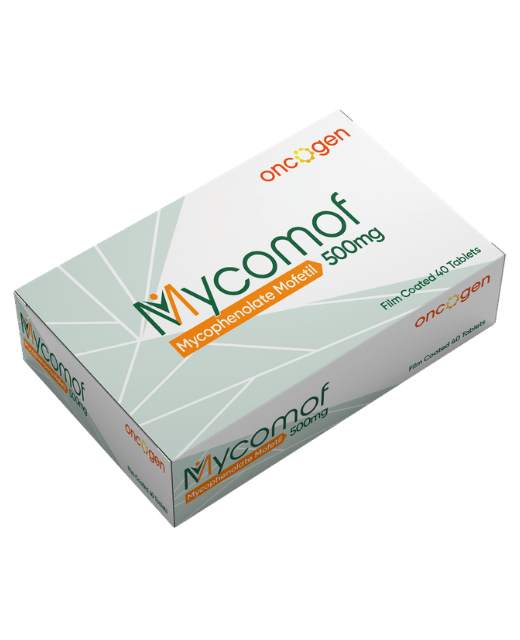
Mycomof mycophenolate mofetil 500mg — Trust has found a new home.
Immunosuppressant

Mycomof (Mycophenolate Mofetil)

Available Strength

  • 500mg
Mycomof (Mycophenolate Mofetil) 500mg film coated tablets

Patient Information

Frequently Asked Questions (FAQs)

Mycomof (Mycophenolate Mofetil) is a prescription-only medicine that lowers the activity of your immune system (an immunosuppressant). It is used together with cyclosporine and corticosteroids to help prevent your body's immune system from rejecting a kidney, heart, or liver transplant. Take Mycomof only as prescribed by your doctor, and do not stop it or change your dose on your own.

Mycomof has been used safely and works in children who have received a kidney transplant, the same as in adults. It is not known if Mycomof is safe and effective in children who receive a heart or liver transplant.

Do not take Mycomof if you are allergic to mycophenolate mofetil, mycophenolic acid, or any of the ingredients in Mycomof.

Mycomof can cause serious side effects, including:

  • Loss of pregnancy and birth defects. Women who take Mycomof during pregnancy have a higher risk of losing the pregnancy during the first 3 months, and a higher risk that their baby will be born with birth defects. If you become pregnant while taking Mycomof, do not stop taking it — call your doctor right away.
  • Increased risk of serious infections. Mycomof weakens your immune system's ability to fight infection. Serious infections — including viral infections such as shingles and cytomegalovirus (CMV), a rare brain infection called progressive multifocal leukoencephalopathy (PML), and fungal infections — can happen and can lead to death.
  • Increased risk of certain cancers, including lymphoma and skin cancer.

Call your doctor right away if you have any signs of infection (a fever of 100.5°F / about 38°C or greater, cold or flu symptoms, an earache or headache, pain when passing urine, white patches in the mouth or throat, unexpected bruising or bleeding, or cuts or scrapes that are red, warm, or oozing pus), or if you notice an unexplained fever, prolonged tiredness, weight loss, swollen lymph nodes, or any new or changing skin spot or mole.

Tell your doctor about all of your medical conditions, including if you:

  • Have any digestive problems, such as ulcers;
  • Have phenylketonuria (PKU) — Mycomof Oral Suspension contains aspartame, a source of phenylalanine;
  • Have Lesch-Nyhan or Kelley-Seegmiller syndrome, or another rare inherited enzyme deficiency (HGPRT) — you should not take Mycomof if you have one of these conditions;
  • Plan to receive any vaccines — live vaccines should be avoided during treatment, and other vaccines may not work as well;
  • Are a woman who is able to become pregnant;
  • Are pregnant or are planning to become pregnant;
  • Are breastfeeding — it is not known if Mycomof passes into breast milk; you and your doctor will decide whether you should take Mycomof or breastfeed.

Also tell your doctor about all the medicines you take, including prescription and over-the-counter medicines, vitamins, and herbal supplements. In particular, tell your doctor if you take:

  • Birth control pills (oral contraceptives);
  • Sevelamer — take it 2 hours after Mycomof;
  • Acyclovir, valacyclovir, ganciclovir, or valganciclovir;
  • Rifampin;
  • Antacids that contain magnesium and aluminum — do not take them at the same time as Mycomof;
  • Sulfamethoxazole/trimethoprim;
  • Norfloxacin and metronidazole;
  • Ciprofloxacin, or amoxicillin plus clavulanic acid;
  • Azathioprine;
  • Cholestyramine.

Keep a list of all the medicines you take to show your doctor and pharmacist when you get a new medicine. Do not start any new medicine without talking with your doctor.

Pregnancy and birth control

If you are a woman who is able to become pregnant:

  • Your doctor must talk with you about effective birth control methods;
  • You should have a negative pregnancy test within 1 week before starting Mycomof;
  • You must use 2 different types of effective birth control at the same time — starting 4 weeks before you begin Mycomof, throughout treatment, and for 6 weeks after stopping — unless you choose complete abstinence. Mycomof can reduce the effectiveness of birth control pills.

If you plan to become pregnant, talk with your doctor first. If you become pregnant while taking Mycomof, do not stop taking it — call your doctor right away, and ask about reporting the pregnancy.

  • Take Mycomof exactly as prescribed. Do not stop taking it or change your dose unless your doctor tells you to.
  • Take Mycomof tablets on an empty stomach, either 1 hour before or 2 hours after a meal, unless your doctor tells you otherwise. With your doctor's approval, stable kidney transplant patients may take it with food if needed.
  • Do not crush Mycomof tablets.
  • If you miss a dose, take it as soon as you remember. If it is almost time for your next dose, skip the missed dose. Do not take 2 doses at the same time. Call your doctor if you are not sure what to do.
  • If you take too much Mycomof, call your doctor right away.

  • Avoid pregnancy (see pregnancy and birth control information above).
  • Limit the amount of time you spend in sunlight, and avoid tanning beds and sunlamps. Mycomof increases the risk of skin cancer. Wear protective clothing and use a sunscreen with a high protection factor (SPF 30 or above), especially if you have fair skin or a family history of skin cancer.

Serious side effects

See the important safety information above. Additional serious effects can include:

  • Low blood cell counts. This includes low white blood cells (raising the risk of infection, most often 3 to 6 months after transplant), low red blood cells (which can cause severe anemia — rarely, Mycomof can stop the body from making red blood cells, a condition called pure red cell aplasia), and low platelets (needed for blood clotting). Your doctor will check your blood counts with regular blood tests before and during treatment.
  • Stomach and bowel problems. Bleeding, ulcers, or a tear (perforation) in the stomach or intestine can happen. Bleeding can be severe and may require hospitalization. Call your doctor right away about severe stomach pain, black or tarry stools, or vomiting blood or material that looks like coffee grounds.

Common side effects

These may include:

  • Diarrhea — call your doctor right away if this happens; do not stop taking Mycomof without first talking with your doctor;
  • Vomiting;
  • Pain, including pain in the stomach area;
  • Swelling of the lower legs, ankles, and feet;
  • High blood pressure.

Side effects that happen more often in children than in adults

These include stomach-area pain, fever, infection, pain, blood infection (sepsis), diarrhea, vomiting, sore throat, colds (respiratory tract infections), high blood pressure, low white blood cell count, and low red blood cell count.

These are not all of the possible side effects. Tell your doctor about any side effect that bothers you or that does not go away.

For further information

This page is a general summary and does not replace the advice of your doctor or the full prescribing information. For complete details, including all warnings, precautions, and side effects, please contact our team using the Prescribing Information button above. Always follow your doctor's instructions.

Need more information about Mycomof?

Share your product inquiry with the Oncogen Pharma team. We will respond with relevant information for formal healthcare, partnership, or product availability discussions.

Get in Touch